
UnitedHealth Group Stock Surges on Q1 2026 Results as Outlook Improves
UnitedHealth Group (NYSE: UNH) delivered a steady set of first-quarter 2026 results that reassured investors and triggered a sharp market reaction, with the stock surging roughly 7% following the release. While the headline numbers showed only modest top-line growth, the underlying story is one of operational stabilization, strategic repositioning, and improving policy tailwinds.
Financial Resilience
The company reported first-quarter 2026 revenues of $111.7 billion, a 2% year-over-year increase. Notably, the medical cost ratio was 83.9%, down 90 basis points from Q1 2025, signaling stronger cost management even as healthcare utilization and unit cost trends remain elevated. The operating cost ratio of 13.8% during the quarter compared to 12.4% in Q1 2025, reflecting incremental investments in people, processes and technology, including artificial intelligence, to improve performance and support future innovations, modernization, growth and earnings. As a result, first-quarter 2026 earnings from operations were $9.0 billion, compared to $9.1 billion a year ago.
Net income was $6.5 billion, alongside adjusted earnings per share of $7.23, modestly ahead of the prior year. Net margin was 5.6% compared to 5.7% in the year ago quarter. Cash flows from operations were $8.9 billion, or 1.4x net income, and the debt-to-capital ratio was 42.9% as of March 31, 2026. The company continues to target a long-term debt-to-capital ratio of approximately 40.0% and expects to reach that level in the back half of 2026.
Segment performance
From a segment perspective, UnitedHealthcare remained the primary earnings engine, delivering $5.7 billion in operating income and expanding operating margin to 6.6%. Growth was largely driven by repricing actions amid persistent cost pressures. Meanwhile, the Optum division showed mixed performance: Optum Health faced revenue contraction due to lower value-based care members, while Optum Rx and Optum Insight delivered modest revenue growth but saw operating income compression tied to ongoing investment cycles.
Strategic Realignment and Leadership Refresh
Strategically, management is undergoing a notable transformation phase. The company has refocused on the U.S. healthcare market, marked by the exit of non-U.S. businesses, including the completed divestiture of its Optum UK business; refreshed nearly half of its top 100 leadership roles; and accelerated modernization initiatives—particularly substantial investments in AI and cybersecurity. The pending acquisition of Alegeus Technologies further reinforces its push toward more flexible, consumer-centric healthcare solutions.
Corporate governance has also seen a significant overhaul. The company created a Public Responsibility Committee of the Board, appointed a Lead Independent Director, and added new independent directors to accelerate board recruiting and transparency.
Policy Tailwinds Support Forward Outlook
The external environment is also turning more favorable. The U.S. government’s decision to increase Medicare Advantage payments by 2.48% for 2027—significantly above earlier proposals—provides a favorable tailwind for insurers like UnitedHealth, helping to offset cost pressures and underpin future earnings visibility.
Reflecting this improved outlook, the company raised its full-year 2026 EPS guidance to above $17.35 and adjusted EPS guidance to above $18.25, signaling management’s confidence in sustained operational momentum. The company also has entered an arrangement to buy back at least $2 billion of its common stock, expected to be completed by the end of Q2 2026.
Technical Outlook
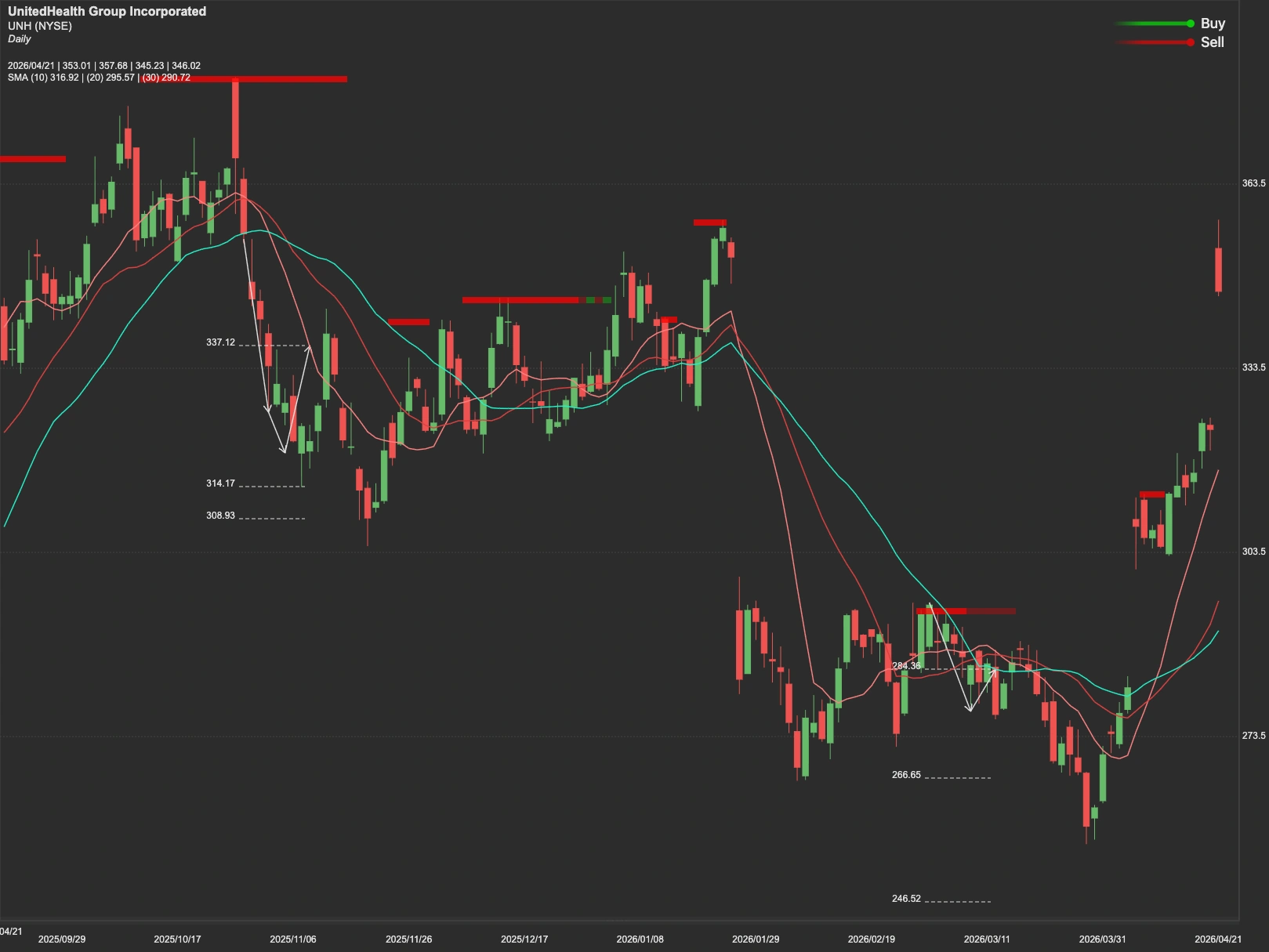
From a technical standpoint, UNH’s post-earnings rally has brought the stock into a critical resistance zone around $378. A decisive breakout above this level could open the path toward the $400 threshold in the near term.
However, failure to sustain momentum above $378 may trigger a pullback, with initial support seen near $310. A deeper correction could test the $290 level, which serves as a stronger support base.
For long-term investors, the key resistance level remains at $427. A sustained move above this threshold would likely indicate a broader bullish continuation, supported by structural growth in healthcare demand and the company’s ongoing transformation initiatives.