
Walmart's 9.2% Post-Earnings Drop Masks a Quietly Strong Quarter
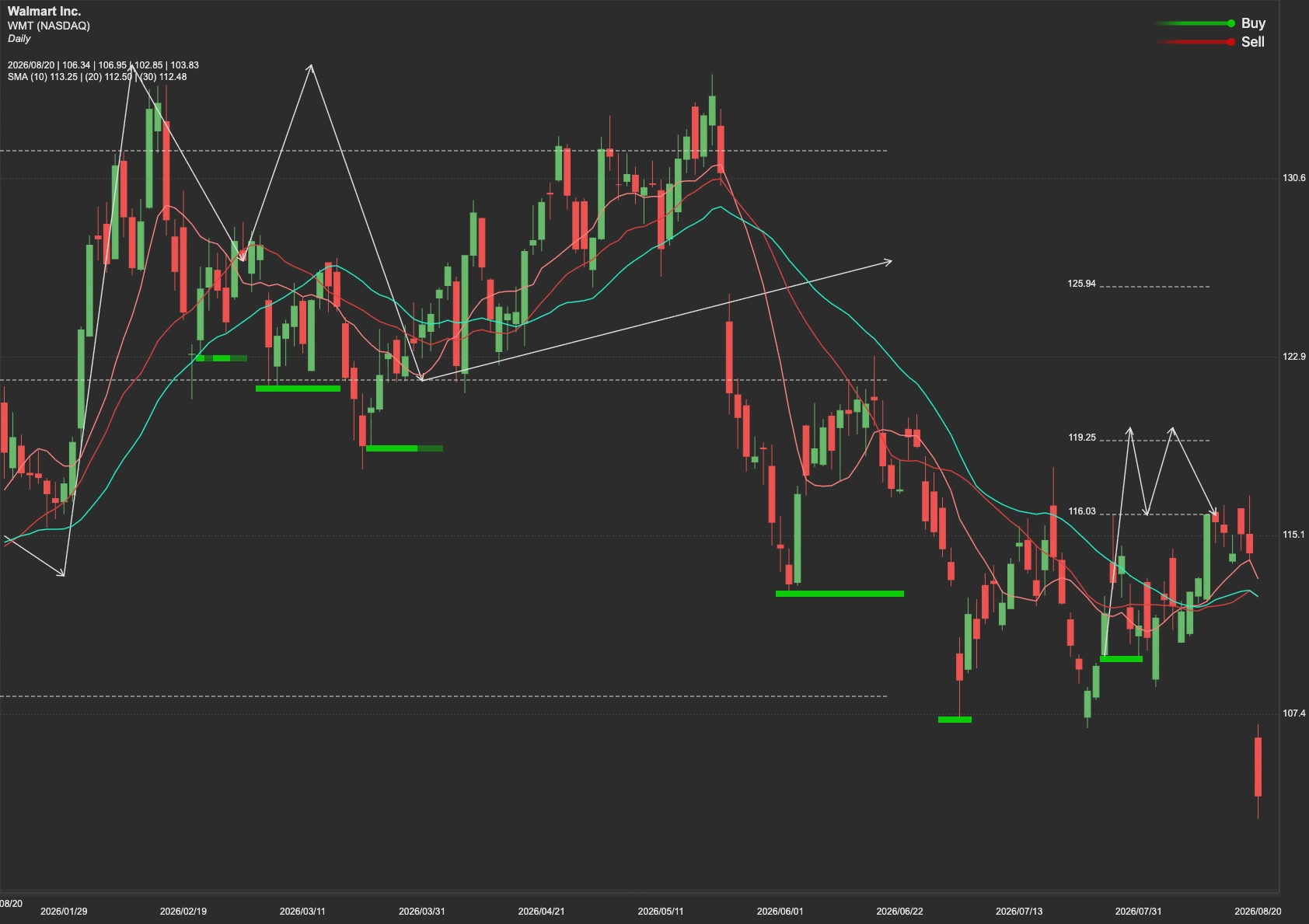
Walmart Inc. (NASDAQ: WMT) reported strong financial results for the second quarter of Fiscal Year 2027, driven by robust performance across global eCommerce, advertising revenue, and membership growth. Despite raising its full-year guidance across revenue, operating income, and adjusted earnings per share (EPS), WMT stock experienced a 9.2% pull-back following the announcement.
Revenue Growth Remains Healthy
Walmart generated second-quarter revenue of $187.9 billion, an increase of 5.9% year over year, or 5.1% in constant currency. Global eCommerce sales jumped 23%, driven by store-fulfilled pickup and delivery alongside marketplace expansion. Global advertising business climbed 38%, with strength across segments. Walmart U.S. advertising up 38%. Membership fee revenue globally rose 17%.
Gross margin expanded 96 basis points to 25.4%, helped by tariff refunds and favorable business mix led by global advertising. Operating income jumped $2.1 billion, or 28.8%, to $9.4 billion. Roughly 750 bps of the operating-income growth came from tariff refunds received during the quarter (about $2.9 billion). Strip that out and underlying operating-income growth landed at the top of the company's own 7%–10% guidance.
Diluted EPS of $0.80, down 9.1% from $0.88 a year ago, and net income attributable to Walmart of $6.4 billion, down 9.4%. That decline traces to "Other gains and losses," where a net investment loss of $0.12 per share replaced a year-ago gain. Adjusted EPS was $0.81, an increase of 19.1%, excluding the impact, net of tax, from a net loss of $0.12 on equity and other investments, and net benefit of $0.11 from a certain tax matter.
Year-to-date operating cash flow increased to $19.7 billion. Free cash flow for the year-to-date was $5.5 billion, down $1.4 billion, driven by a $2.8 billion increase in capital expenditures to support the omnichannel build.
The company ended the quarter with $11.5 billion in cash and cash equivalents against $57.2 billion of total debt (including short-term borrowings, long-term debt, and finance lease obligations).
During the quarter, Walmart returned significant capital to shareholders through $3.0 billion of share repurchases and $2.0 billion in dividend payments, while retaining $25.1 billion under its current buyback authorization.
Segment Performance
Walmart U.S.: Net sales rose 3.5% year over year to $125.2 billion, with comparable sales (excluding fuel) up 2.6% versus 4.6% a year ago. The segment saw a 24% boost in eCommerce sales and a 20.6% gain in operating income to $8.1 billion. However, pharmacy deflation related to new maximum fair price regulation (effective Jan 1) created a 125 basis point headwind to U.S. comps.
CFO John David Rainey noted that "when looking at the Walmart U.S. total comps, including health and wellness, during each of FY 2025 and FY 2026 we realized 100 basis points of a tailwind from sales of GLP-1 branded drugs. In FY 2027, the benefit from GLP-1 is expected to be roughly half that amount, as script count growth is more than offset by price/mix headwinds. New in FY 2027, we cited a 100 basis points headwind to total comp sales from deflation and brand to generic transfers under the first year of maximum fair price regulation. In Q2, this negative impact was closer to 125 basis points, and we've updated our estimate for FY 2027 impact to be similar at 125 basis points."
Walmart International: Net sales increased 12.8% year over year to $35.2 billion, driven by balanced store and digital momentum across global markets. eCommerce sales up 19%, led by store-fulfilled pickup & delivery, with digital mix up across markets. Advertising business grew 20%, led by Flipkart Ads.
Sam’s Club U.S.: Net sales surged 8.8% to $25.7 billion, with comp sales (ex-fuel) rising 4.4% on strong transaction volume (+7.0%) and 26% growth in eCommerce sales.
Management Raises Full-Year Guidance
Walmart raised full-year FY27 guidance: net sales +4.0%–5.0% (from +3.5%–4.5%), adjusted operating income +7.0%–8.5% (from +6.0%–8.0%), and adjusted EPS $2.80–$2.87 (from $2.75–$2.85). Notably, the company is guiding higher despite the fuel cost and a softer consumer than when the February outlook was set.
Management now expects CapEx at approximately 4% of annual net sales (up from ~3.5%) and more than $2 billion of incremental fuel-related costs this year versus original assumptions. The company also expects costs related to the acquisition and integration of Vibe to be an approximate 20 basis points headwind to OI growth.
For the third quarter, Walmart expects net sales growth of 3.0% to 3.75%, adjusted operating income growth of 2.0% to 4.0%, and adjusted EPS between $0.62 and $0.64.
WMT Stock Technical Analysis
Following the earnings release, WMT shares dropped by 9.2%. Currently, $119 has become the key resistance level. A decisive breakout and sustained move above this level would improve market sentiment and could open the path toward the next upside target around $130.
However, if the stock fails to reclaim and hold above $119, the post-earnings pullback could extend downward. The first major support is located near $91, while a deeper correction could see the shares test the stronger support around $84.