
AMD Delivers Record Second Quarter as Data Center Revenue Doubles
AMD (NASDAQ: AMD) delivered another milestone quarter, reinforcing its position as one of the strongest beneficiaries of the accelerating artificial intelligence infrastructure buildout. The company reported record second-quarter 2026 revenue and profitability, driven by exceptional growth in its Data Center business and continued demand for its EPYC server processors and Instinct AI accelerators.
Record Revenue and Strong Profit Growth
AMD generated second-quarter 2026 revenue of $11.5 billion, representing 50% year-over-year growth and 13% sequential growth. The company also delivered significant improvements across every major profitability metric.
On a GAAP basis:
- Gross profit increased 103% year-over-year to $6.2 billion
- Gross margin expanded to 54%, up from 40% a year ago
- Operating expenses of $4.2 billion, up 32% year-over-year
- Operating income reached $2.0 billion
- Operating margin up 19 ppts to 17%
- Net income climbed to $2.3 billion
- Diluted earnings per share increased to $1.38
On a non-GAAP basis:
- Gross margin improved to 56%
- Operating income rose to $3.1 billion
- Operating margin up 15 ppts to 27%
- Net income reached $2.8 billion
- Diluted EPS increased to $1.66
The strong comparison also reflects the fact that the prior-year quarter included an $800 million inventory charge related to U.S. export restrictions on AMD Instinct MI308 data center GPU products.
During the quarter, operating cash flow totaled $2.37 billion, and free cash flow reached $1.56 billion. AMD ended Q2 2026 with an enviable liquidity profile, holding $5.1 billion in cash and cash equivalents alongside $8.0 billion in short-term investments against just $3.2 billion in total debt. Nvidia, as AMD's one of the most competitors, has released the Q1 Fiscal 2027 results; for more details, visit NVIDIA Stock Analysis: AI Demand Continues to Drive Record Revenue.
Segment Performance
The Data Center segment delivered $6.7 billion in revenue — up 107% year-over-year and now 58% of total company revenue — fueled by strong demand for AMD EPYC processors and Instinct GPUs. That single segment more than doubled, and management expects its momentum to accelerate in the back half of the year. "We enter the second half with strong momentum as EPYC demand accelerates, Instinct deployments scale and Helios begins to ramp," said Chair and CEO Dr. Lisa Su, pointing to AI as the structural force expanding compute demand across every market AMD plays in.
Beyond the data center, the rest of the portfolio held up well. The Client and Gaming segment posted $3.8 billion (up 6% YoY), with Client revenue of $3.1 billion surging 23% on Ryzen strength, even as Gaming slid 31% to $779 million on lower semi-custom sales. Embedded segment grew 19% to $977 million as demand strengthened across multiple end markets.
AI Strategy Continues to Expand
AMD spent the quarter aggressively strengthening its AI ecosystem.
-
Helios rackscale AI server — the world's most powerful AI server rack, delivering leadership inference tokens per dollar. It is already being deployed by leading AI labs and cloud providers including Anthropic, Cirrascale, HUMAIN, Meta, Microsoft, OpenAI, Oracle, Tensorwave, and Vultr.
-
Instinct MI400 Series GPU family — including the MI455X for leadership compute, memory capacity, and bandwidth in large-scale AI training and inference, plus the MI430X, described as the most advanced accelerator for HPC and sovereign AI workloads.
-
6th Gen AMD EPYC server CPUs — built to deliver leadership performance across agentic AI, general-purpose, and enterprise workloads.
-
ROCm. ai —an AI-native developer experience designed to help developers build, deploy, and optimize faster across AMD platforms.
-
Strategic partnership with Anthropic — a deal to deploy up to 2 gigawatts of MI450 Series GPUs inside AMD Helios racks, paired with a multiyear collaboration to optimize Instinct GPUs and ROCm software development using Claude.
-
Expanded Microsoft collaboration — deploying Helios racks at scale on Azure for frontier model inference, adding two new EPYC CPU-powered VM series, and broadening Pensando DPUs deployments to support Azure networking services.
-
Cerebras collaboration — combining Helios with the Cerebras Wafer-Scale Engine to improve efficiency, scalability, and economics for ultra-low-latency inference serving.
-
Instinct MI350P GPU — designed to bring seamless AI acceleration to existing infrastructure with leadership token economics.
-
Acquisition of MEXT — adding AI-powered predictive memory technology to optimize memory use and expand usable capacity for AI workloads.
Q3 2026 Outlook
For Q3 2026, AMD expects revenue of roughly $13 billion (±$300 million) — a mid-point implying ~41% year-over-year growth and ~13% sequential growth — with non-GAAP gross margin holding near 56%. CFO Jean Hu framed it plainly: Data Center sales are set to accelerate, driving stronger overall growth and continued earnings expansion.
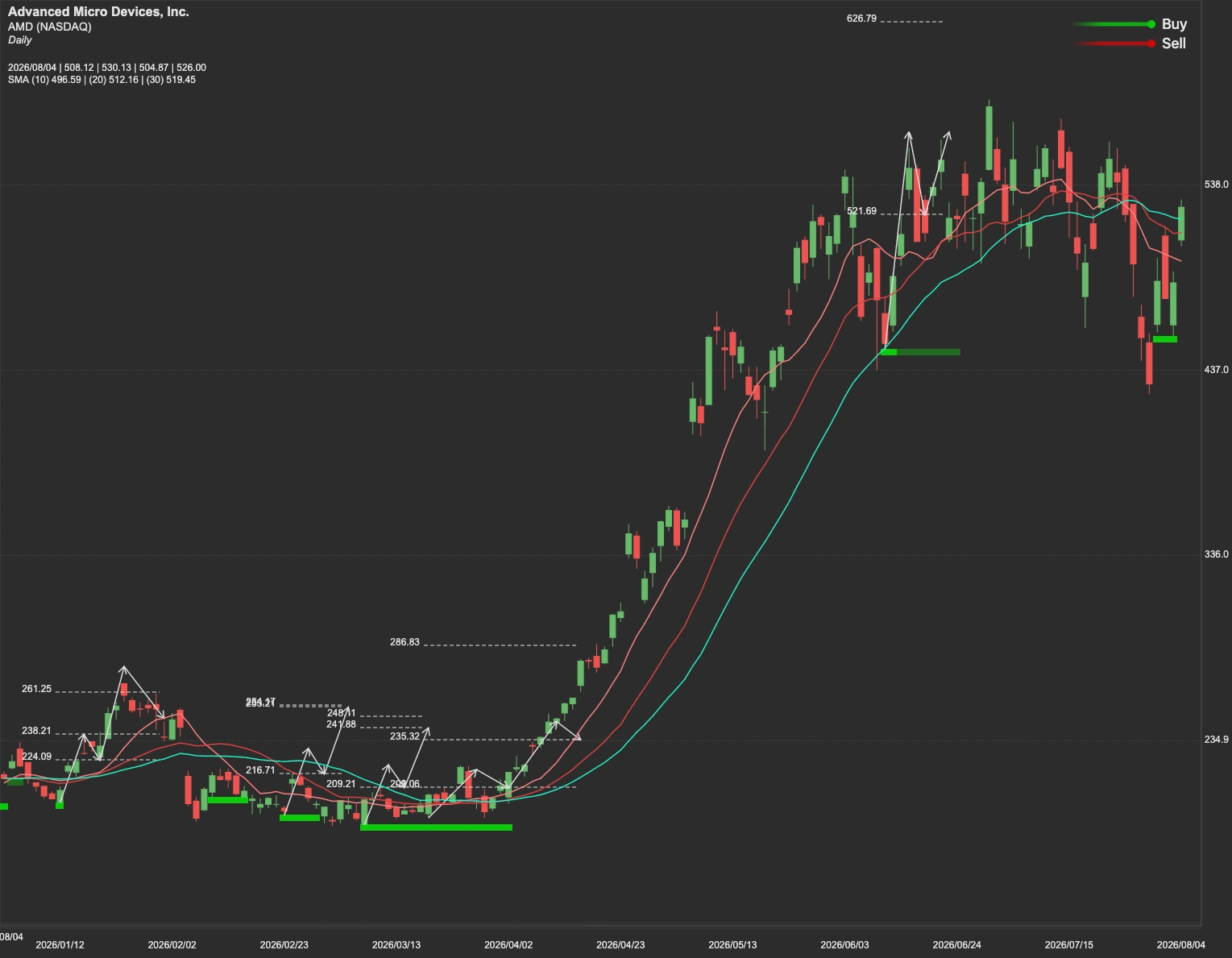
AMD Stock Technical Analysis
From a technical perspective, the key resistance level is $553 for AMD stock. A decisive breakout and sustained move above this level would strengthen bullish momentum and could open the path toward the next major upside target around $600.
However, if AMD fails to break above $553, short-term traders may take profits, leading to a technical pullback. The first important support level is $428. If selling pressure increases and this support fails, AMD could potentially revisit the deeper support zone around $395.