
Target Reports Strong Q2 Results as Traffic Growth and Digital Sales Drive Momentum
Target Corporation (NYSE: TGT) delivered a robust second-quarter financial performance, demonstrating that its strategic focus on value, convenience, and category differentiation is yielding tangible results. With positive top-line momentum, expanding margins, and an updated full-year outlook, the retailer is positioning itself for sustained growth.
Sales Growth Is Showing Better Quality
Second-quarter net sales increased 5.3% year over year to $26.5 billion, while comparable sales rose 3.8%, driven primarily by a 3.6% increase in traffic, with average ticket about flat.
The improvement was broad-based. Store comparable sales increased 2.7%, while digitally originated comparable sales jumped 8.7%. Same-day delivery was particularly strong, growing more than 25%. Target also reported sales growth across all six core merchandising categories, with Fun 101 delivering double-digit growth and Food & Beverage and Beauty posting high-single-digit growth. Apparel & accessories was essentially flat (+0.1%), and Home furnishings & décor was flat too (+0.2%). On the call, Chief Merchandising Officer Cara Sylvester acknowledged that "As we've said before, this transformation won't happen all at once. In some categories, we're pleased with our progress, and we're seeing meaningful momentum. In others, including home and apparel, our performance is not where it needs to be, and the work will continue into 2027 and beyond."
Non-merchandise sales increased 20.1% in the quarter, supported by strong growth in Roundel advertising, Target Circle 360 membership revenue and the Target+ marketplace.
Roundel gross billings increased nearly 20%, Target Plus marketplace GMV grew more than 40%, and Target Circle 360 membership revenue increased more than 40% year over year.
Profitability Improved, but Tariff Refunds Distort the Comparison
Target's second-quarter gross margin was 33.7%, compared with 29.0% a year earlier. However, the improvement was significantly influenced by $994 million of tariff refunds, which contributed 3.7 percentage points to the gross margin rate. Excluding tariff refunds, Target said gross margin expanded by approximately 100 basis points year over year. The improvement reflected easier comparisons against elevated markdowns and purchase order cancellation costs in the prior year, as well as continued growth in higher-margin non-merchandise revenue.
Second quarter SG&A expense rate was 21.6 percent, compared with prior-year SG&A expense rate of 21.3 percent. This increase reflects the impact of higher compensation costs, including additional hours for field teams and higher incentive compensation, as well as planned spending related to capital projects.
Operating income reached $2.6 billion, compared with $1.3 billion last year. The operating margin rose to 9.6% from 5.2%, although 3.7 percentage points of the current-year margin reflected tariff refunds. Excluding the tariff benefit, operating margin still improved by approximately 70 basis points.
Second quarter net earnings were $1.9 billion, which included tariff refund benefits of $752 million, compared with prior-year net earnings of $935 million. Second-quarter GAAP and adjusted EPS were $4.11, compared with $2.05 a year earlier, an increase of 100%. Tariff refunds contributed $1.65 per share. Excluding the refunds, EPS increased 20% year over year. Furthermore, Walmart recently released Q2 FY27 financial results, more information visit: Walmart's 9.2% Post-Earnings Drop Masks a Quietly Strong Quarter.
Investment in Stores and Digital Capabilities Remains High
Target is increasing investment to support its longer-term growth strategy. Second-quarter capital expenditures rose 27% to $1.4 billion, primarily reflecting investments in store remodels and new stores.
Capital expenditures reached approximately $2.4 billion during the first half of 2026, nearly 30% above the prior year. Management continues to expect approximately $5 billion of capital expenditures for the full year, with spending directed toward stores, supply chain capabilities, and technology.
The company paid $518 million in dividends during the quarter and did not repurchase shares. However, management expects to resume share repurchases during the second half of the year, subject to operating performance, cash generation, and capital expenditure plans.
Target ended the quarter with $5.4 billion in cash and cash equivalents and $15.4 billion in total debt. Its trailing-12-month after-tax return on invested capital (ROIC) improved to 15.4% from 14.3% a year earlier, indicating that the improvement in operating profitability is translating into better capital efficiency.
Target Raises Its 2026 Outlook
Management raised its full-year sales outlook following the stronger first half. Target now expects 2026 net sales growth in a range around 5%, one percentage point higher than its previous guidance.
The company expects its full-year operating margin rate to be around 6%, including approximately 90 basis points of benefit from the Q2 tariff refunds. Excluding tariff refunds, Target expects its operating margin rate to be approximately 50 basis points above the 4.6% adjusted operating margin achieved in 2025.
Target also raised its full-year GAAP and adjusted EPS guidance to $9.90-$10.90 from the previous $7.50-$8.50 range. The updated guidance includes approximately $1.65 per share from Q2 tariff refunds; while excluding those refunds, the midpoint represents a $0.75 increase compared with the previous guidance range.
TGT Stock Technical Analysis
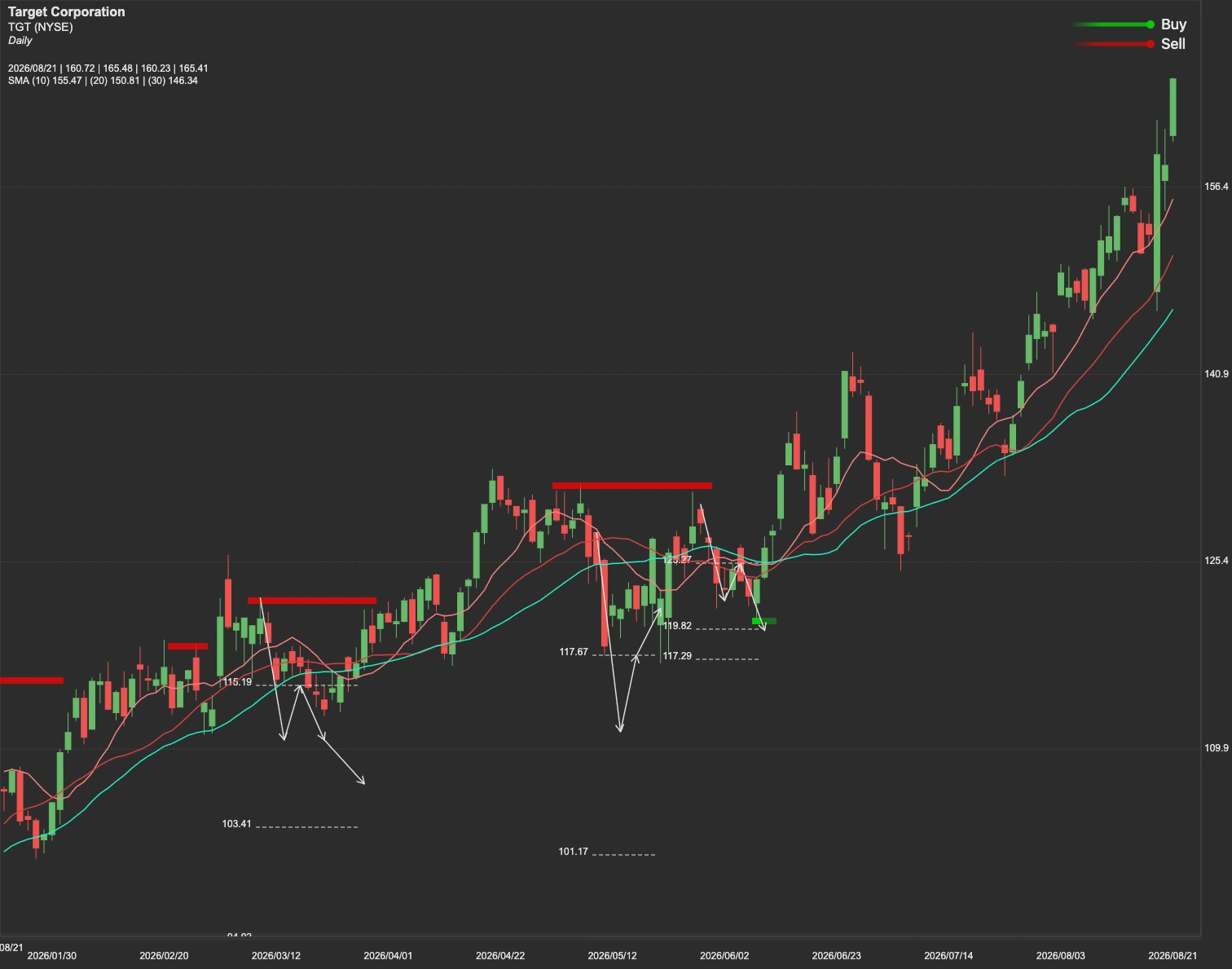
From a technical perspective, $176 is currently the most important resistance level for TGT. If TGT holds above $176, the breakout opens the path to the next meaningful resistance at $193 — a level that, if cleared, would confirm the fundamental recovery is being endorsed by the market and likely invite momentum follow-through.
However, if $176 rejects the price, the bull case loses its near-term footing, and the stock is likely to seek support. The first downside target is $146. A break below that would expose the deeper support zone of $135–$118.