
Walmart Delivers Strong Q4 Growth as Digital and Advertising Momentum Accelerates
Walmart Inc. (NASDAQ: WMT) delivered a solid fourth quarter to close fiscal 2026, reinforcing its position as a resilient retail leader navigating a rapidly evolving consumer landscape. With total revenue hitting $190.7 billion—a 5.6% increase—the retail giant is proving that its investments in digital convenience and automated logistics are paying off.
Revenue and Operating Leverage Improve Quality of Growth
Fourth-quarter revenue rose 5.6% to $190.7 billion, or 4.9% in constant currency, supported by 4.6% comp sales growth in Walmart U.S. and continued transaction gains. Full-year revenue increased 4.7% to $713.2 billion. As an e-commerce giant, Amazon also announced its financial results recently, with Q4 sales of $213.4 billion and full-year 2025 sales of $716.9 billion. More details in the article: Amazon Stock Analysis After Q4 and Full-Year 2025 Results.
More importantly from a margin structure perspective, gross margin expanded 13 basis points in the quarter, while full-year gross margin reached 24.2%. Operating income grew 10.8% to $8.7 billion in Q4, or 10.5% on an adjusted (cc) basis, materially outpacing sales growth. For full year, operating income up 1.6% to $29.8 billion, up 5.4% on an adjusted (cc) basis. Although full-year operating margin eased to 4.2% from 4.4% last year, the fourth-quarter operating margin up to 4.6%, compared with 4.4% a year earlier.
For fourth quarter, reported EPS declined 18.5% year over year to $0.53 due primarily to a $0.21 per-share net loss on equity and other investments. Excluding these items, adjusted EPS rose 12.1% to $0.74, signaling underlying earnings strength. For fiscal 2026, reported EPS expanded 13.3% to $2.73, and adjusted EPS reached $2.64, up 5.2% year over year.
eCommerce and Advertising Drive Structural Upside
One of the most compelling aspects of Walmart’s performance is its accelerating digital ecosystem. Global eCommerce sales grew 24% in Q4, led by store-fulfilled pickup and delivery and marketplace strength. In Walmart U.S., eCommerce sales climbed 27% in Q4, with expedited delivery channels growing more than 50%, highlighting the effectiveness of its omnichannel strategy.
Advertising has quietly become a high-margin growth engine. The global advertising business expanded 37% in Q4 and 46% for the full year to nearly $6.4 billion (including VIZIO). Strong advertising growth continued; Walmart Connect sales (ex-VIZIO) in the U.S. in Q4 rose 41%.
Membership fee revenue also increased 15.1% globally in Q4, reinforcing the recurring revenue component of Walmart’s ecosystem.
Segment Performance: U.S. Stability, International Momentum
Walmart U.S. posted 4.6% net sales growth to $129.2 billion in Q4, driven by increased transactions and digital engagement. Operating income grew 6.6%, reflecting improved gross margins and disciplined cost control. Inventory rose only 2.9%, below sales growth, suggesting healthy stock management.
Internationally, net sales increased 11.5% (7.5% in constant currency) to $35.9 billion in Q4, with strength in China, Walmex, and Flipkart. Adjusted operating income in constant currency grew 26.5% in Q4, benefiting from lower eCommerce losses and better operating efficiency.
Sam’s Club U.S. continued steady progress, with 4.0% ex-fuel net sales growth to $21.7 billion in Q4 and 23% eCommerce growth. Membership trends remained healthy, reinforcing recurring revenue visibility.
Balance Sheet and Capital Allocation
Walmart ended the year with $10.7 billion in cash and generated $41.6 billion in operating cash flow. Free cash flow totaled $14.9 billion despite higher capital expenditures to support omnichannel growth.
The company repurchased $8.1 billion of shares year-to-date and announced a new $30 billion share repurchase authorization, signaling confidence in long-term cash generation.
For FY27, management guides net sales growth of 3.5%–4.5% and adjusted operating income growth of 6%–8% in constant currency, with adjusted EPS expected between $2.75 and $2.85. Capital expenditures are expected to be approximately 3.5% of net sales.
Technical Analysis
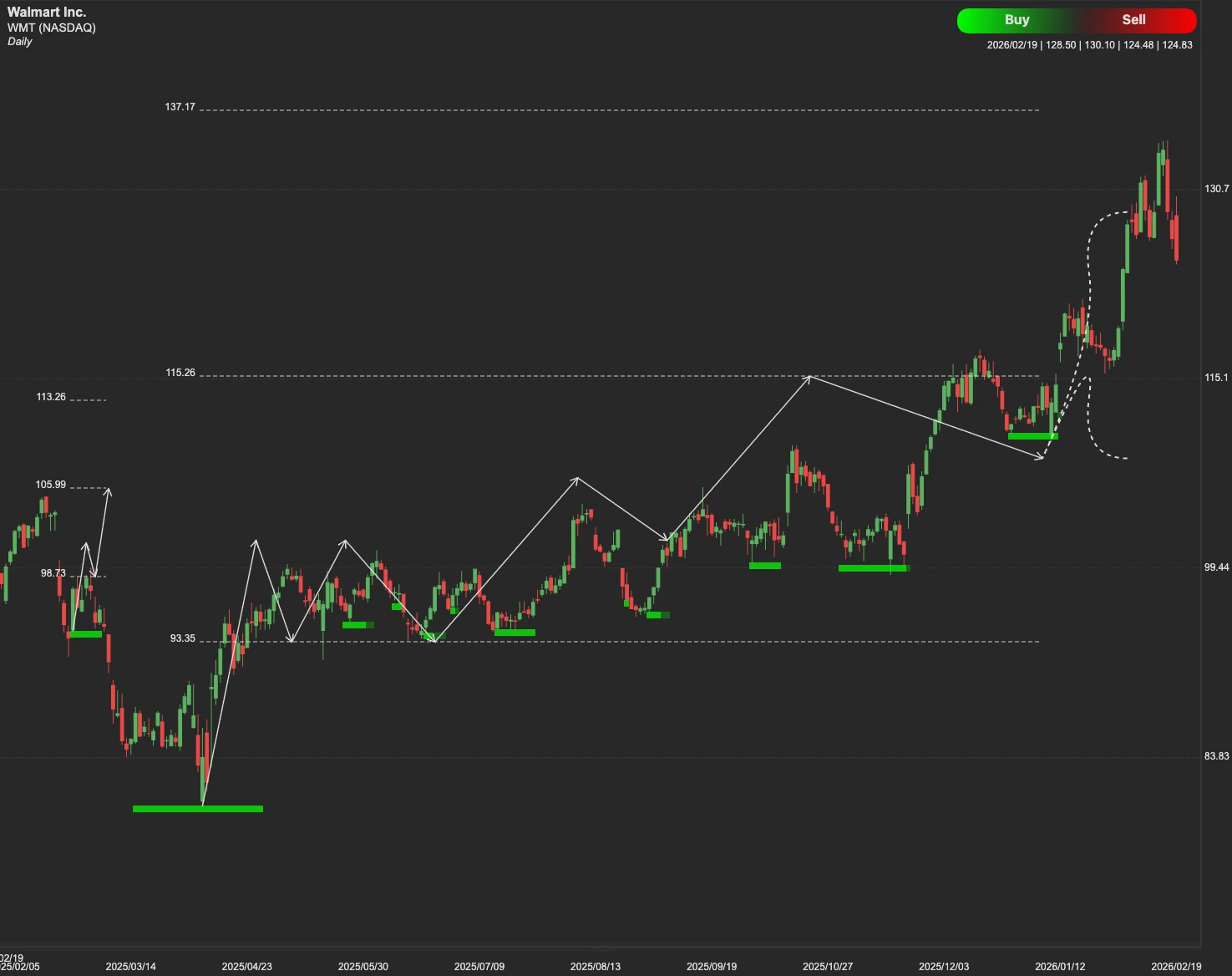
From a technical perspective, WMT is currently facing an immediate hurdle at the $131 resistance level. If WMT can maintain a daily close above $131, it clears the "air pocket" for a move toward the next major price target of $138. Strong guidance and the new buyback program provide the fundamental tailwinds needed for this breakout.
Should the stock fail to overcome $131, we may see a period of consolidation or a retracement. In a downward scenario, the first significant level of support sits at $108. If market volatility increases or retail sentiment shifts, a secondary, deeper support level at $96 represents a long-term value floor for investors.