Kroger Stock Analysis: Strong Earnings Discipline Amid Slower Sales Growth
Kroger Stock Analysis: Strong Earnings Discipline Amid Slower Sales Growth
The Kroger Co. (NYSE: KR) delivered a mixed second quarter in 2026. While sales momentum remained weaker than expected, the company continued to demonstrate that it has several levers available to protect profitability and earnings growth.
Kroger Delivers Earnings Growth Despite Softer Sales
Second-quarter total sales reached $34.6 billion, up from $33.9 billion a year earlier. However, excluding fuel, Vitacost and exited fulfillment centers, sales increased only 0.1%. Identical sales without fuel rose 0.2%, compared to 3.4% growth in the same period last year.
The weaker top line was affected by several temporary and structural factors. Kroger cited the Inflation Reduction Act as an approximately 140-basis-point headwind, while the shift from branded to generic prescriptions reduced identical sales by another 60 basis points. Cyclospora-related disruption in produce and the ongoing effects of egg deflation also weighed on sales.
Kroger's second-quarter gross margin was 22.4%, slightly below 22.5% a year earlier. Higher shrink, transportation costs, the mix effect of higher fuel sales, and investments in customer value pressured the reported margin.
However, the FIFO gross margin rate excluding rent, depreciation and amortization and fuel increased 13 basis points year over year. Improvement in eCommerce profitability and media, a favorable pharmacy mix, sourcing initiatives and tariff refunds helped offset some of the cost pressures. Kroger also recorded a lower LIFO charge of $39 million, compared with $62 million in the prior-year quarter.
Operating performance strengthened during the quarter. Operating profit increased to $971 million from $863 million, while the operating margin improved to 2.8% from 2.5%. Net earnings attributable to Kroger rose to $641 million from $609 million, and diluted EPS increased to $1.05 from $0.91.
On an adjusted basis, adjusted FIFO operating profit reached $1.1 billion, while adjusted EPS increased 5% year over year to $1.09.
Pharmacy, Fuel and eCommerce Support Earnings
Kroger's underlying business showed mixed trends across different categories. Natural foods, meat and seafood, and bakery delivered strong results, while the company's core pharmacy business remained healthy. Prescription volumes increased, with continued momentum in GLP-1 medications.
Fuel remained another contributor to profitability. Kroger's fuel gallons increased during the quarter and outperformed the broader industry market by approximately 520 basis points. Fuel rewards and additional promotions helped increase redemptions by nearly 6% year over year.
The company also continued to improve the profitability of its eCommerce business. Management expects further gains in eCommerce profitability and continued growth in its media business to contribute to earnings during the second half of fiscal 2026.
Balance Sheet and Shareholder Returns
Kroger ended the second quarter with $1.676 billion in cash and temporary cash investments and $16.997 billion in total debt. Its net total debt-to-adjusted EBITDA ratio was 1.91, up from 1.63 a year earlier but still below the company's target range of 2.30 to 2.50.
The balance sheet gives Kroger flexibility to continue investing in its operations while maintaining its investment-grade debt rating. During the quarter, the company completed 12 major store projects designed to increase market density and support future growth.
Kroger also continued returning capital to shareholders. The company increased its dividend by 11% during the quarter, marking its 20th consecutive year of dividend increases. It also repurchased $1.0 billion of shares during the quarter, bringing year-to-date repurchases to $1.2 billion under its $2 billion authorization.
Approximately $800 million remained under the authorization at the end of the second quarter, and Kroger expects to complete the remaining repurchases by the end of fiscal 2026. Share repurchases are expected to provide additional support to EPS growth during the second half of the year.
Full-Year Earnings Guidance Remains Unchanged
Although Kroger lowered its full-year identical sales without fuel guidance from 1%-2% to 0.2%-0.8%, management maintained its full-year adjusted FIFO operating profit guidance of $5.0 billion to $5.2 billion and adjusted diluted EPS guidance of $5.10 to $5.30.
The company also maintained its free cash flow guidance of $2.7 billion to $2.9 billion and capital expenditure guidance of $3.8 billion to $4.0 billion.
Management expects cost-saving initiatives to build through the second half of the year, while pharmacy margins, eCommerce profitability and the media business are expected to provide additional earnings support.
However, Kroger expects sales comparisons to remain challenging. The company expects lingering effects from Cyclospora to weigh on third-quarter sales, while the fourth quarter is expected to face additional pressure from the anniversary of third-party delivery partnerships and weather-related sales benefits recorded in the prior year. As a result, management anticipates identical sales without fuel will be slightly better in Q3 than in Q4.
KR Stock Technical Analysis
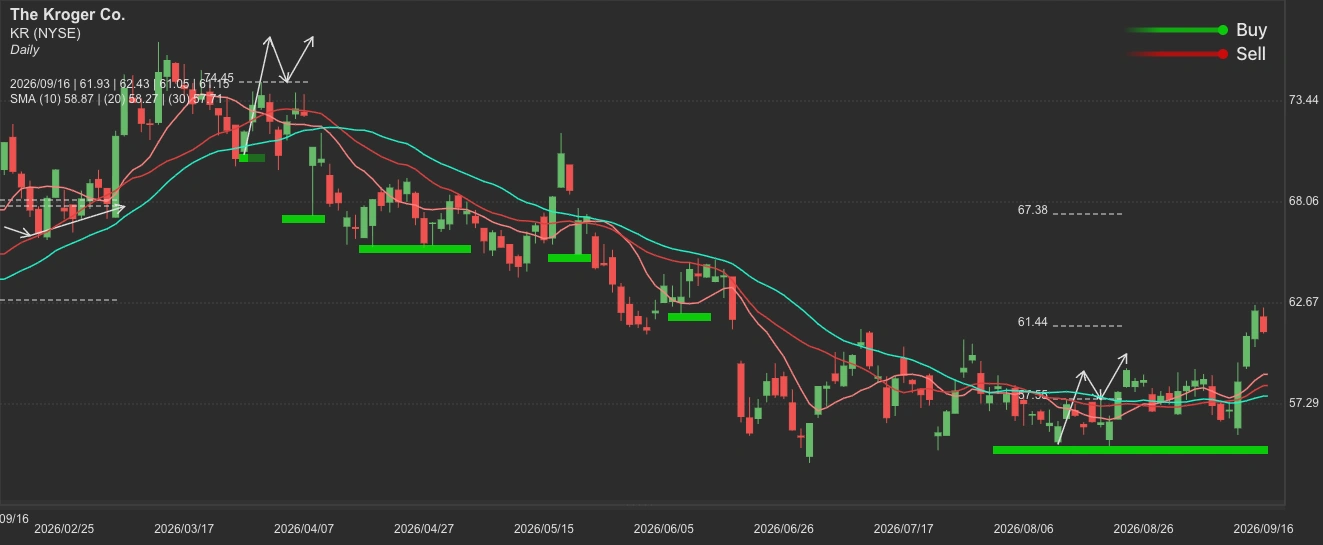
From a technical perspective, KR currently faces resistance around $69. If the stock can stand above the $69 level, the next potential price objective is around $76.
On the other hand, failure to hold above $69 could leave the stock vulnerable to another move lower. The first important support level is around $53, while $44 represents a further downside support area if the $53 level fails.