Macy’s Stock Analysis: Improving Fundamentals Meet a Key Technical Test
Macy’s Stock Analysis: Improving Fundamentals Meet a Key Technical Test
Macy’s, Inc. (NYSE: M) delivered a stronger-than-expected second quarter in fiscal 2026, with comparable sales growth across all three of its nameplates and improvements in profitability, driven by its strategic "Bold New Chapter" transformation.
But the story is more layered than the top-line summary suggests — and nowhere is that clearer than in the balance between what the quarter genuinely achieved and what came from a one-time tariff refund windfall. Understanding that distinction is the key to reading both the fundamentals and the stock's technical set-up.
Strong Second-Quarter Performance
The company reported net sales of $4.9 billion, representing a 1.1% increase from the second quarter of 2025. Excluding the impact of fiscal 2025 store closures, net sales increased 1.9%.
Macy’s, Inc. comparable sales increased 2.7% and were positive at each of the company’s nameplates. The company’s go-forward business comparable sales growth of 2.8%.
The performance was supported by growth across Macy’s, Bloomingdale’s and Bluemercury. Macy’s comparable sales increased 1.1%, while its Reimagine 200 stores recorded a stronger 1.9% increase. Bloomingdale’s remained a significant growth contributor, with comparable sales rising 11.3%, marking its second consecutive quarter of double-digit comparable sales growth. Bluemercury also continued to expand, posting a 6.2% increase in comparable sales.
Profitability Improved Despite Modest Revenue Growth
Macy’s, Inc.'s second-quarter profitability improved substantially compared with the same period last year. Gross margin increased to 41.5%, up 180 basis points year over year. However, the improvement was significantly influenced by tariff refunds. Excluding the 180-basis-point benefit from net tariff refunds and a 10-basis-point headwind from ongoing tariff and fuel costs, gross margin increased by 10 basis points.
Selling, general and administrative expenses increased by $16 million to $1.96 billion, reflecting higher variable costs associated with sales growth and investments in the company’s Bold New Chapter initiatives. Nevertheless, SG&A expense as a percentage of total revenue declined 20 basis points to 38.7%, indicating some operating leverage and continued cost discipline.
GAAP operating income increased to $244 million from $149 million a year earlier, while the GAAP operating margin improved to 4.8% from 3.0%. Adjusted EBITDA rose to $457 million from $373 million, with the adjusted EBITDA margin increasing to 9.0% from 7.5%.
GAAP diluted EPS doubled to $0.62 from $0.31, while adjusted diluted EPS increased to $0.63 from $0.35. The company said both measures included a net tariff refund benefit of $0.23 per share during the quarter. Excluding the tariff refund benefit, adjusted EPS still showed underlying improvement, up 14% compared with the prior-year period.
Balance Sheet and Liquidity Remain Solid
Macy’s, Inc. ended the second quarter with $1.3 billion in cash and cash equivalents, compared with $0.8 billion a year earlier. The company also had $2.0 billion of available borrowing capacity under its asset-based credit facility.
Total debt stood at $2.4 billion at the end of the quarter, while the company does not face material long-term debt maturities until 2030.
Merchandise inventories increased 2.5% year over year. Macy’s, Inc. indicated that inventory composition and levels were appropriately positioned for the second half of fiscal 2026.
Tariff Refunds Provide Additional Investment Capacity
Tariff refunds were an important factor in Macy’s, Inc. second-quarter results and full-year outlook. The company received $98 million of IEEPA tariff refunds during the quarter and another $18 million after quarter end, bringing total refunds received to $116 million.
Macy’s, Inc. plans to reinvest $96 million into the business during 2026. These investments are intended to support customer initiatives, the Bold New Chapter strategy and longer-term growth. Approximately $20 million of the refunds is expected to flow through to full-year EPS.
Macy’s, Inc. Raises Full-Year 2026 Guidance
Following the stronger second-quarter performance, Macy’s, Inc. raised its fiscal 2026 guidance across several key metrics. The company now expects full-year net sales of $21.675 billion to $21.825 billion, compared with its previous range of $21.5 billion to $21.75 billion.
The comparable sales outlook was also raised to growth of 1.0% to 1.5%, compared with the previous range of 0.5% to 1.2%. Comparable sales guidance reflects management's expectation that Macy's Reimagine 200 locations and digital performance will be partially offset by the go-forward Macy's locations that have not yet received initiatives and the stores the company has planned for closures in 2026 and beyond
Adjusted EBITDA as a percentage of total revenue is now expected to be 7.8% to 8.0%, up from the previous range of 7.7% to 7.9%.
Macy’s, Inc. also increased its adjusted diluted EPS guidance to $2.15 to $2.35, compared with the previous range of $2.00 to $2.20.
The revised outlook suggests that management expects the improvements across its brands, cost controls and investments in key stores to continue contributing to results through the remainder of fiscal 2026. At the same time, the company continues to acknowledge potential risks from macroeconomic conditions, geopolitical developments, discretionary consumer spending and changes in the competitive environment.
Near-Term Outlook Remains More Cautious
While the full-year outlook was raised, Macy’s, Inc. third-quarter guidance indicates that the company expects a softer near-term operating environment. The company forecasts third-quarter net sales of $4.65 billion to $4.70 billion, with comparable sales ranging from a 0.5% decline to 0.5% growth.
Adjusted EBITDA rate is expected to be between 3.7% and 4.0%, while adjusted diluted EPS is projected at negative $0.23 to negative $0.19.
Share Repurchases and Dividends Support Shareholder Returns
Macy’s, Inc. continued returning capital to shareholders during the quarter. The company paid $51 million in dividends during the second quarter, bringing first-half dividend payments to $101 million.
The company also repurchased 2.2 million shares for $50 million during the second quarter. Including earlier repurchases, Macy’s, Inc. bought back 4.9 million shares for $100 million during the first half of 2026.
As of the end of the second quarter, approximately $1.0 billion remained available under the company's $2.0 billion share repurchase authorization.
M Stock Technical Analysis
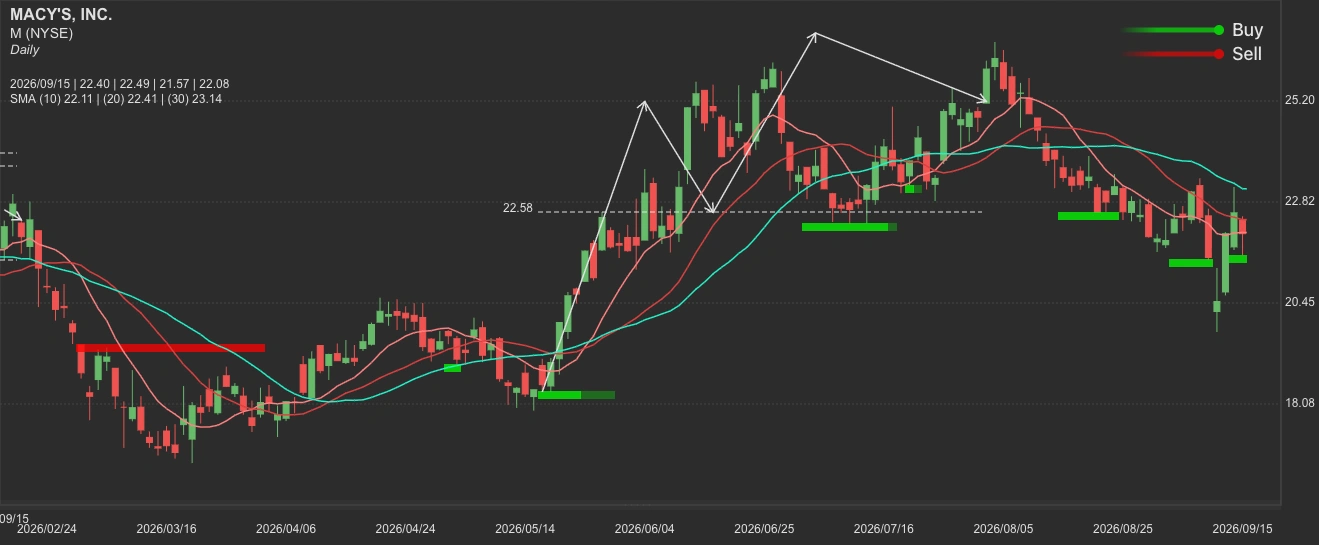
From a technical perspective, M currently faces a key resistance level at $27. If the stock can move above and sustain trading above $27, the next key resistance level is $31.
Conversely, if M fails to hold above the $27 resistance area, the stock could instead come under selling pressure and move toward the $17 support level. A further decline could bring the $10 support level into focus.