Dollar Tree’s Profitability Surges, but Investors Should Look Beyond Tariff Refunds
Dollar Tree’s Profitability Surges, but Investors Should Look Beyond Tariff Refunds
Dollar Tree, Inc. (NASDAQ: DLTR) delivered a strong second-quarter performance, with solid comparable-store sales growth, significant margin expansion, and earnings that exceeded the high end of its previous outlook. While the company's underlying business continues to improve, investors need to distinguish between sustainable operating gains and the temporary boost from tariff refunds.
Strong Sales Growth and Positive Customer Traffic
Dollar Tree reported second-quarter net sales of $4.9 billion, representing a 7.0% increase from the prior-year period. Comparable-store net sales increased 3.7%, supported by both higher customer spending and increased traffic. Average ticket increased 3.3%, while traffic rose 0.4%.
The company opened 75 new Dollar Tree stores during the quarter and converted or added approximately 710 stores to its multi-price format. The number of multi-price stores reached approximately 6,600 out of a total 9,436 store footprint by the end of the quarter.
Margin Expansion and EPS Performance
The most notable feature of the quarter was the sharp improvement in profitability. Dollar Tree's gross profit margin increased 850 basis points year over year to 42.9%. However, investors should look carefully at the source of this improvement. Approximately 680 basis points of the increase came from the net impact of tariff refunds. The remaining improvement was primarily attributed to lower tariff rates, favorable shrink trends, and occupancy leverage, partially offset by sales mix.
Operating income reached $690 million, producing an operating margin of 14.1%. The margin expanded 900 basis points from the prior-year period. Again, tariff refunds were responsible for a substantial portion of the improvement, contributing 650 basis points to the operating margin expansion.
The company's effective tax rate was 25.0%, compared to 25.5% in the prior-year period.
Income from continuing operations was $515 million, while diluted EPS reached $2.70. Importantly, approximately $1.31 of quarterly EPS benefited from the net impact of tariff refunds.
Liquidity and Capital Allocation
Dollar Tree generated $922 million of net cash from operating activities from continuing operations during the quarter and $675 million of free cash flow.
The company also repurchased 5.6 million shares for $605 million during the quarter, excluding applicable excise tax. As of August 1, Dollar Tree had $2.5 billion remaining under its share repurchase authorization.
Dollar Tree ended the quarter with $1.1 billion of cash and cash equivalents and $2.9 billion of long-term debt. The company had no commercial paper outstanding and no borrowings under its revolving credit facility.
Outlook and Full-Year Guidance
Management expects fiscal 2026 net sales from continuing operations of $20.5 billion to $20.7 billion, based on comparable-store sales growth of 3% to 4%. The company expects approximately 400 new store openings and 75 closings during the fiscal year. Adjusted diluted EPS is expected to range from $7.70 to $8.05, including an approximate $0.60 benefit from the net impact of tariff refunds.
For the third quarter, Dollar Tree expects net sales of $5.0 billion to $5.1 billion, based on comparable-store sales growth of 3% to 4%. Diluted EPS is expected to range from $0.80 to $0.95, including an approximate $0.50 impact related to tariff refund reinvestments.
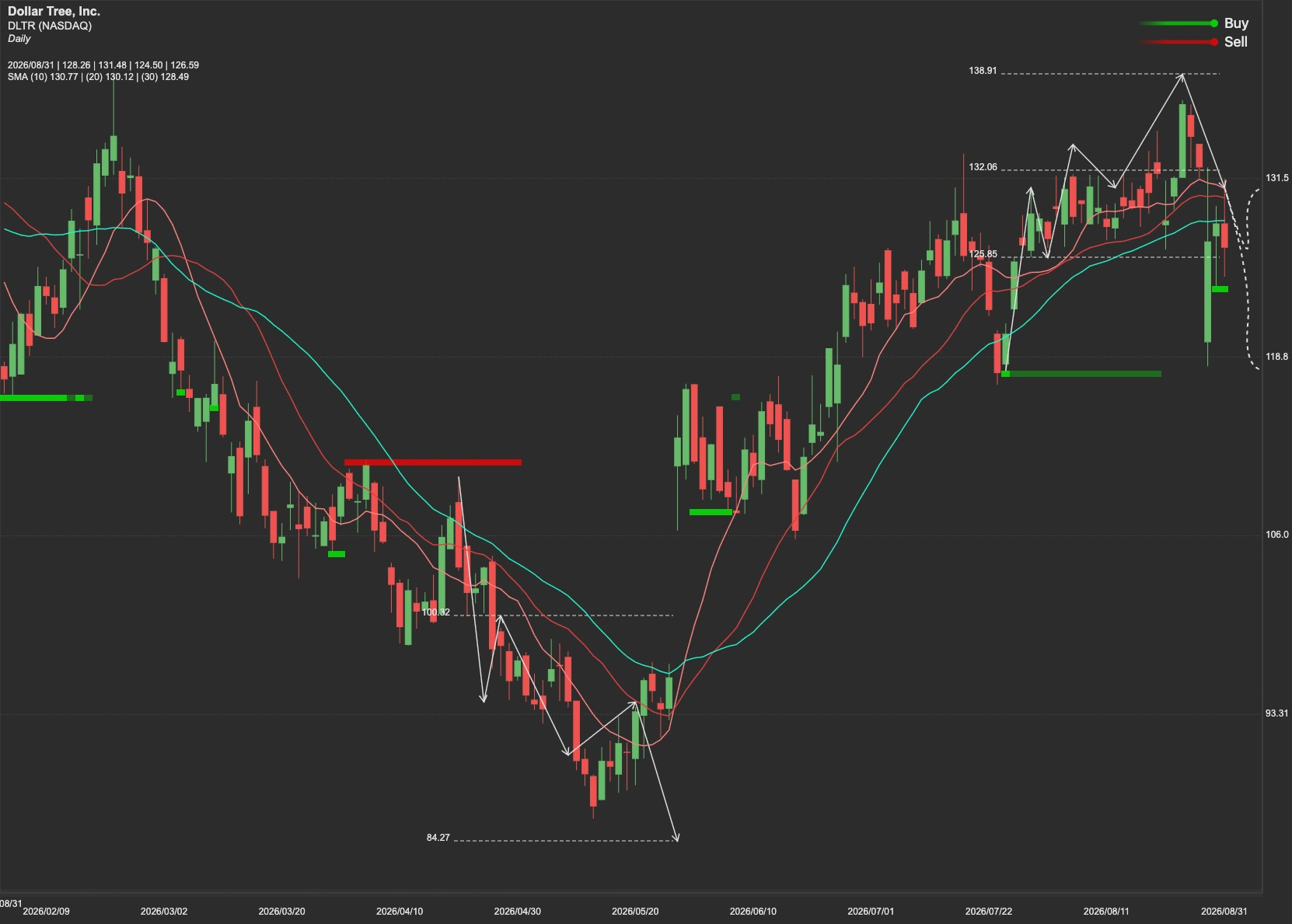
DLTR Stock Technical Analysis
From a stock-price perspective, $141 is currently an important resistance level for DLTR. If the stock can decisively move above and hold above $141, the next potential upside target is around $152.
On the other hand, failure to break above $141 could lead to renewed selling pressure. In that scenario, $110 represents an important potential support level. If $110 fails to hold, investors could look toward the $97–$89 area as the next broader support zone.